
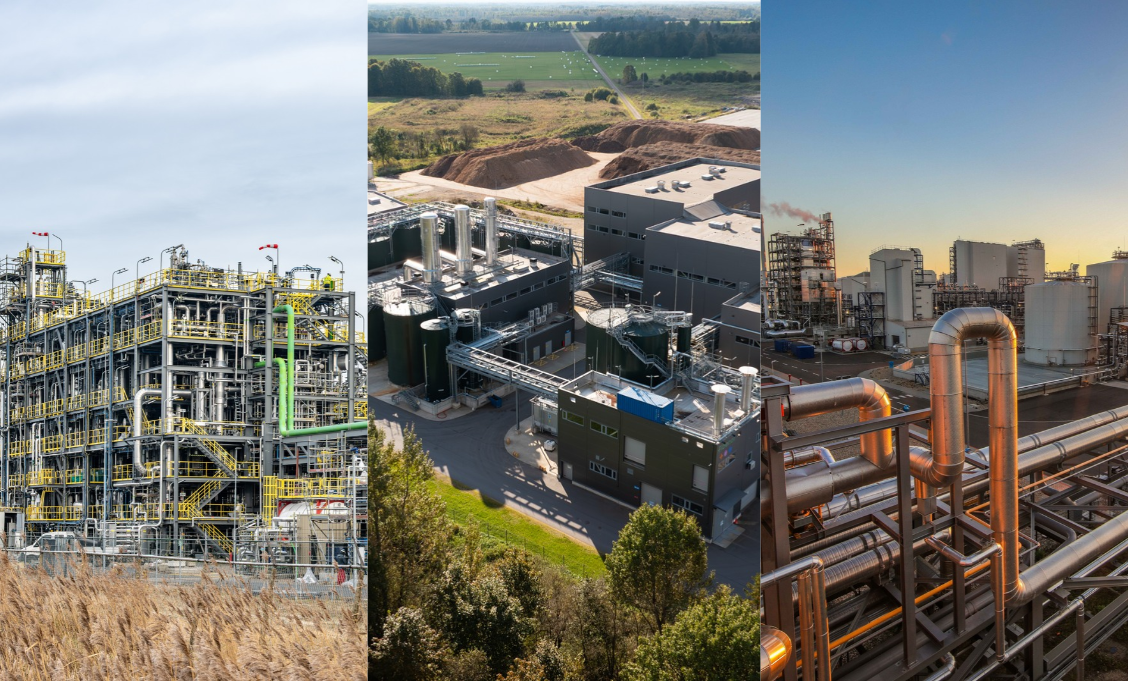
BIC published Winning the First-of-a-Kind Challenge, a study on what it takes to move a new bio-based technology from first commercial plant to industrial reality. Its insights come straight from three European first-of-a-kind (FOAK) projects:
- UPM, Leuna, Germany: a biorefinery that turns certified regional hardwood into renewable chemicals and materials.
- Avantium, Delfzijl, the Netherlands: the world’s first industrial-scale plant producing FDCA, the plant-based building block for PEF.
- Fibenol, Imavere, Estonia: a hardwood biorefinery producing lignin and wood sugars.
The study’s central finding is that FOAK success depends less on removing uncertainty than on making it manageable early enough. A first plant is not proven when it is built or opened. The decisive tests often come later, during commissioning, ramp-up and customer qualification.
The report draws four lessons for developers, investors and policymakers:
- Financing must cover commissioning, ramp-up and customer qualification, not just construction.
- Beginning with one controlled feedstock route leads to faster learning. Flexibility can be added later.
- Letters of intent show interest, but binding or condition-based offtake agreements give investors stronger evidence.
- Recognising bio-based carbon, credible claims, workable certification and demand signals such as mandates, targets and public procurement help customers act on the value of bio-based products.
“Given how long it takes to plan, build and ramp up a FOAK plant, 2040 is effectively tomorrow. The decisions we take today will shape how Europe produces for decades to come,” said Marco Rupp, Deputy Executive Director of BIC. “A clear political agenda and a strong EU budget for the bioeconomy will help deploy more first-of-a-kind plants in Europe.”
The study comes at a key moment, as the EU negotiates its 2028–2034 budget and moves to deliver the EU Bioeconomy Strategy.
The study was prepared for BIC by Melich Seefeldt (Via Solutis). It is based on structured expert interviews with the three companies, with each company reviewing and validating the findings before publication.
